
China Best Fluorinated Rubber Manufacturers and Suppliers

Choosing the right Fluorinated Rubber manufacturer or supplier requires more than comparing product prices. It demands careful attention to compound design, production controls, and application conditions. Fluoroelastomers must withstand heat, fuels, oils, chemicals, pressure, and repeated compression without losing their sealing function. A supplier’s technical depth often matters more than its catalog size.

Dr. John Scheirs, a recognized polymer scientist and author of Modern Fluoropolymers, offers a practical message: “Material selection must begin with the service environment, not the product label.” That principle is especially important when evaluating manufacturers in China. Reliable companies should provide clear material grades, test data, batch traceability, and practical support for molding, curing, and dimensional control. Their facilities should also demonstrate consistent quality management rather than relying on attractive claims.

Details reveal experience. Ask how a supplier measures compression set after heat aging. Check whether production samples match the approved specification. Confirm packaging, storage guidance, and response procedures for nonconforming goods. These points may seem ordinary. They are not.

A strong manufacturer should understand that a seal exposed to 200°C, aggressive fuel, and vibration faces a different challenge from a static gasket in clean equipment. Some supplier pages still use vague descriptions. That weakness deserves attention. Technical language alone does not prove performance.

This guide examines leading China Fluorinated Rubber manufacturers and suppliers through product capability, quality evidence, customization, delivery reliability, and technical service. The aim is not to praise every company. It is to help buyers make a more informed, test-based decision.
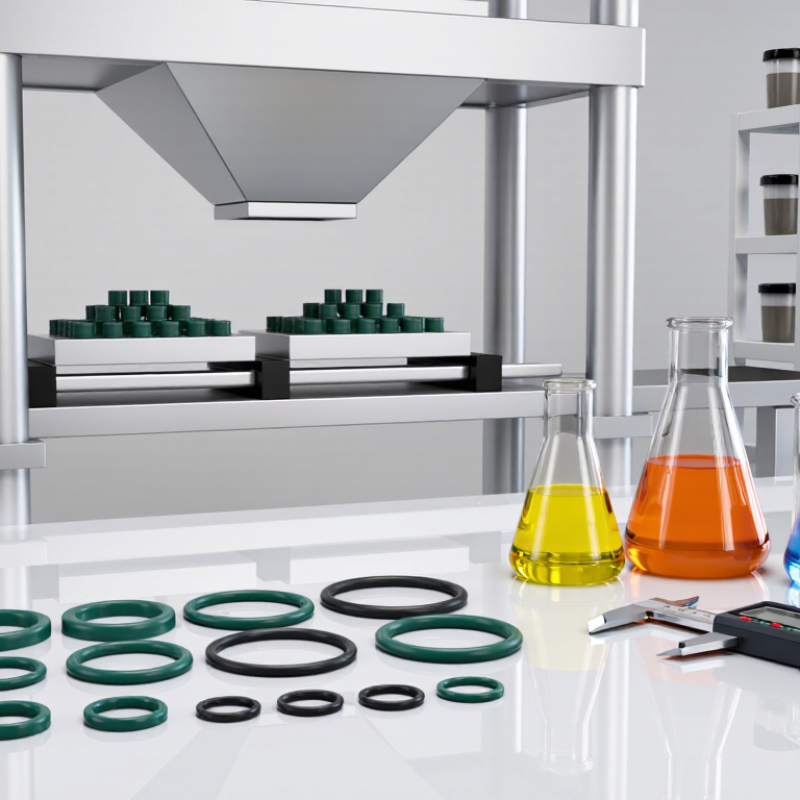
China Best Fluorinated Rubber Manufacturers and Suppliers

What Is Fluorinated Rubber and Why Is It Used?

Fluorinated rubber, commonly called FKM or fluoroelastomer, is a synthetic rubber with a high fluorine content. Its strong carbon-fluorine bonds help it withstand oils, fuels, solvents, and many aggressive chemicals. It also performs reliably at elevated temperatures. In practical use, a molded O-ring may face hot oil, pressure changes, and repeated compression without losing its sealing function quickly.

That durability explains its use in engines, pumps, valves, aircraft systems, and chemical processing equipment. It offers low gas permeability and good resistance to swelling, which can protect sensitive assemblies from leaks. Engineers usually check hardness, compression set, chemical compatibility, and operating temperature before selecting a compound. A seal that feels firm in the hand may still fail after long exposure.

Fluorinated rubber is not a universal answer. Some grades lose flexibility in very cold conditions, while certain amines, hot water, or steam can cause serious damage. Cost is also higher than many general-purpose elastomers. From supplier evaluations, traceability and batch testing matter as much as a technical datasheet. Ask for test results under conditions close to actual service. Catalog ratings can look convincing, but real pressure cycles, surface finish, and installation quality may change performance. This is where careful engineering judgment remains necessary.

Key Properties and Applications of Fluorinated Rubber

Fluorinated rubber is valued for its strong resistance to heat, fuels, oils, and aggressive chemicals. Its fluorine-rich structure limits swelling when seals contact harsh fluids. It also performs reliably across wide temperature ranges. However, it is not a universal solution. Low-temperature flexibility can become a concern in cold environments. Compression set may also increase when the compound or design is poorly matched.

In practical equipment testing, fluorinated rubber often suits fuel systems, hydraulic seals, valve components, and chemical processing equipment. It can protect against leaks near hot pumps and engine compartments. A seal may look perfect during installation but fail after repeated pressure cycles. Material hardness, fluid composition, temperature, and surface finish all affect service life. Reliable manufacturers and suppliers should provide batch information, test data, and clear compound specifications. These details support traceable purchasing and safer engineering decisions.

Tips: Confirm the actual operating temperature and fluid before selection. Test the seal under realistic pressure and movement conditions. Do not judge performance by fluorine content alone. Ask for compression-set and chemical-resistance data. Small design gaps matter. Supplier quality can vary, so inspection remains worthwhile.

China Best Fluorinated Rubber Manufacturers and Suppliers - Key Properties and Applications of Fluorinated Rubber

The chart shows representative continuous service-temperature ranges for common fluorinated elastomer families. Actual performance depends on formulation, compound grade, pressure, media, and exposure time. FKM is widely used for chemical-resistant seals, O-rings, fuel-system components, and automotive applications; FFKM is selected for demanding chemical and high-temperature sealing; FVMQ is used where fluorocarbon resistance and low-temperature flexibility are both required.

How to Evaluate Chinese Fluorinated Rubber Manufacturers

Evaluating Chinese fluorinated rubber manufacturers requires more than comparing prices. Grand View Research estimated the global fluoroelastomers market at about USD 1.7 billion in 2023, with steady growth through 2030. This demand increases pressure on suppliers to prove capacity, consistency, and technical support. Ask for batch records, production dates, and test methods. A polished sample is not enough.

Check whether the factory controls Mooney viscosity, hardness, tensile strength, compression set, and fluorine content. Request test results linked to ISO 23936, ASTM D1418, or another agreed standard. Independent laboratory verification is valuable. Look closely at sealing rings after heat aging, not only before use. Poor compression recovery often appears later. That is the costly surprise.

Supplier audits should cover mixing rooms, mold storage, calibration records, and material traceability. The 2024 MarketsandMarkets assessment projected continued growth in high-performance elastomers, driven by automotive, chemical, and energy applications. This suggests stronger demand for stable compounds, but market forecasts are not factory evidence. Require three recent production batches and compare their results. Confirm lead times, minimum order quantities, and change-control procedures in writing. Experience says many evaluations stop too early. A site video may hide weak controls. When possible, inspect the plant personally or use an independent auditor.

Leading Production Capabilities and Supplier Services in China

China’s fluorinated rubber sector combines compound development, mold production, and export-oriented quality control. Leading manufacturers commonly support FKM, FFKM, and specialized compounds for seals, hoses, pumps, and high-temperature systems. Their factories often connect mixing, molding, post-curing, and inspection in one production flow. This reduces transfer delays and improves batch traceability.

MarketsandMarkets estimates the global fluoroelastomers market could grow from about USD 1.5 billion in 2023 to over USD 2 billion by 2028. Grand View Research also identifies automotive, aerospace, and chemical processing as major demand sectors. These trends explain China’s investment in automated mixing equipment, controlled curing ovens, and laboratory testing. Typical supplier services include compound matching, prototype tooling, dimensional inspection, and documentation for international purchasing. Details matter. A reliable supplier should provide material certificates, hardness records, compression-set results, and aging data. ISO 9001-based systems can strengthen process consistency, but certification alone proves little without stable production records.

Production capability is not only measured by machine numbers. It includes technical response speed, mold accuracy, and the ability to reproduce a compound after months. Some suppliers still depend heavily on manual adjustments. That weakness deserves honest review. Buyers should request sample approval, lot-to-lot test data, and clear lead-time commitments before placing larger orders. The best service model combines engineering communication with practical packaging, shipment coordination, and after-sales analysis. In China, this integrated support can shorten development cycles, although performance must always be verified under the customer’s actual temperature, pressure, and chemical conditions.

Quality Standards, Customization, and Export Considerations

China Best Fluorinated Rubber Manufacturers and Suppliers

Quality begins with traceable compounding, not attractive catalogs. MarketsandMarkets estimates the global fluoroelastomers market will grow at roughly 5% annually through 2029. This growth increases pressure on Chinese suppliers to prove consistency. Buyers should request batch records, hardness results, tensile data, compression-set values, and aging tests. ASTM D1418 identifies FKM families, while ASTM D2000 and SAE J200 support material classification. A reliable supplier should link every test result to a production batch.

Customization must match the working environment. Temperature, fuel type, pressure, and sealing geometry all matter. A compound for automotive fuel systems may fail in concentrated chemicals. Ask for samples using the final seal dimensions. Check performance after heat exposure, not only before it. Small details matter. Color, surface finish, tolerance, and packaging should appear on the drawing. No checklist is perfect; I have seen technically strong compounds fail because the molding shrinkage was ignored.

Export planning requires practical documents. Commercial invoices, packing lists, certificates of analysis, and consistent HS-code descriptions reduce customs delays. ITC Trade Map data shows China remains a major participant in global rubber-product trade, but shipment volume does not guarantee technical reliability. Confirm pallet protection, storage temperature, shelf-life marking, and moisture control. For regulated applications, request applicable compliance declarations before payment. A pre-shipment inspection is useful, although it cannot replace a qualified laboratory test.

China Best Fluorinated Rubber Manufacturers and Suppliers - Quality Standards, Customization, and Export Considerations

Category Data Dimension Relevant Fact or Common Requirement Buyer Verification Point
Material Primary fluorinated rubber type FKM, also known as fluoroelastomer, is widely used for resistance to fuels, oils, mineral-based hydraulic fluids, and many high-temperature applications. Confirm the polymer family, fluorine content, cure system, and application temperature range in the technical data sheet.
Material Specialty grades Low-Temperature FKM, peroxide-cured FKM, FEPM, and FFKM may be selected when standard FKM does not meet temperature, chemical, steam, or plasma requirements. Request media-compatibility data for the exact fluid, concentration, pressure, temperature, and exposure duration.
Quality Standard Rubber material classification ASTM D2000 provides a system for classifying rubber products by type, class, hardness, and specified test requirements. Check that the quotation and test report identify the applicable ASTM D2000 line callout where required.
Quality Standard Dimensional tolerances ISO 3302-1 defines dimensional tolerance classes for molded and extruded rubber products, including general-purpose tolerance grades. Agree on the tolerance class, critical dimensions, measurement method, and inspection sampling plan before production.
Quality Standard O-ring requirements ISO 3601 is commonly used for O-ring dimensions, designation, quality acceptance, and inspection requirements. Specify the standard size, cross-section, inside diameter, hardness, visual acceptance criteria, and permissible flash.
Testing Hardness Shore A hardness is commonly reported for FKM molded parts, with the selected value depending on sealing load, extrusion risk, and system design. Define the target hardness and tolerance, test standard, conditioning period, and measurement location.
Testing Tensile and elongation properties Tensile strength and elongation at break are normally evaluated using standardized rubber test methods such as ASTM D412 or ISO 37. Compare batch test results with the approved compound specification rather than relying only on nominal values.
Testing Compression set Compression set indicates the ability of an elastomer to recover after prolonged compression and is important for static sealing performance. Specify test temperature, duration, specimen geometry, and acceptance limit because results vary significantly with test conditions.
Customization Part design Custom parts may include O-rings, oil seals, gaskets, diaphragms, valve components, molded profiles, and extruded cords. Submit a dimensioned drawing or 3D model showing sealing surfaces, grooves, parting lines, tolerances, and critical features.
Customization Compound formulation Compound selection can be adjusted for chemical resistance, low-temperature flexibility, compression set, friction, color, electrical properties, or processing requirements. Use a signed material specification covering polymer type, filler system, cure system, hardness, and restricted substances.
Customization Color and identification Fluoroelastomer parts can be produced in different colors when the formulation and application permit; color should not replace material traceability. Define color tolerance, marking method, packaging labels, lot number, production date, and material batch traceability.
Application Temperature capability Standard FKM is generally selected for high-temperature service, while the actual continuous-use limit depends on compound, stress, environment, and exposure time. Validate the compound using application-specific aging tests instead of using a single generic temperature figure.
Application Chemical compatibility FKM generally performs well with many hydrocarbons and mineral oils but may be unsuitable for some hot water, steam, amine, ketone, or strong-base environments. Require immersion results covering volume change, hardness change, tensile retention, and appearance after exposure.
Compliance Food-contact suitability Food-contact compliance is application- and formulation-specific; applicable requirements may include FDA 21 CFR 177.2600 or relevant regional food-contact legislation. Request a supplier declaration, formulation status, migration documentation, and test reports for the intended food-contact conditions.
Compliance Restricted substances Export buyers may request declarations related to REACH, RoHS, conflict minerals, PFAS restrictions, or other substance-control requirements. Identify the destination-market requirements and obtain current declarations for the exact compound and article.
Export Commercial documentation Typical export documents include a commercial invoice, packing list, transport document, and, when requested, certificate of origin and inspection or test documentation. Confirm the required documents, consignee details, product description, tariff classification, quantity, and declared value before shipment.
Export Incoterms and logistics The selected Incoterms rule defines responsibilities for transport, insurance, export clearance, import clearance, and transfer of risk. State the Incoterms edition and named place in the purchase contract, and separately confirm lead time and freight arrangements.
Export Packaging and storage Rubber products should be protected from excessive heat, ozone, direct sunlight, contamination, deformation, and incompatible chemicals during storage and transport. Specify packaging quantity, moisture and dust protection, pallet requirements, shelf-life labeling, and storage instructions.
Supplier Evaluation Quality management An ISO 9001-certified quality management system can support controlled processes, corrective actions, document control, and traceability, but certification alone does not guarantee product suitability. Review the certificate scope, process controls, inspection records, calibration status, and nonconformance-management procedure.
Supplier Evaluation Pre-shipment inspection A practical inspection plan may include appearance, dimensions, hardness, packaging, quantity, material identification, and selected physical-property tests. Approve an inspection and test plan with sampling levels, acceptance criteria, reporting format, and corrective-action deadlines.
×
img

    Contact Info

    Phone number

    661-392-8948

    Address info

    3451 Pegasus Drive, Bakersfield, CA USA