How to Choose the Right Valve for Different Applications?

Choosing a valve is not just a matter of matching pipe size. The right choice depends on the fluid, operating pressure, temperature, flow rate, and how often the system must start or stop. A valve handling clean water may not suit abrasive slurry or a corrosive chemical. Small differences matter. A wrong material or seal can lead to leaks, premature wear, or costly downtime.

This guide explains how to compare valve applications and select a suitable design for each operating condition. It covers common types, including gate, globe, ball, butterfly, and check valves, along with their typical strengths and limitations. It also considers body and seal materials, connection styles, actuation, maintenance access, and pressure ratings. These details are practical, but they do not replace the manufacturer’s technical data. Check the specified temperature and pressure limits against real operating conditions, including possible surges. Then review the choice with a qualified engineer when the service is critical or uncertain.

There is no universal best valve. A compact ball valve may work well for quick isolation, while a control valve may provide finer flow adjustment. Yet even that comparison can change with fluid properties and system design. Selection involves trade-offs, and some requirements may be unclear at first. That is worth questioning early. A careful review can help reduce avoidable failures and keep the valve suited to its actual duty.
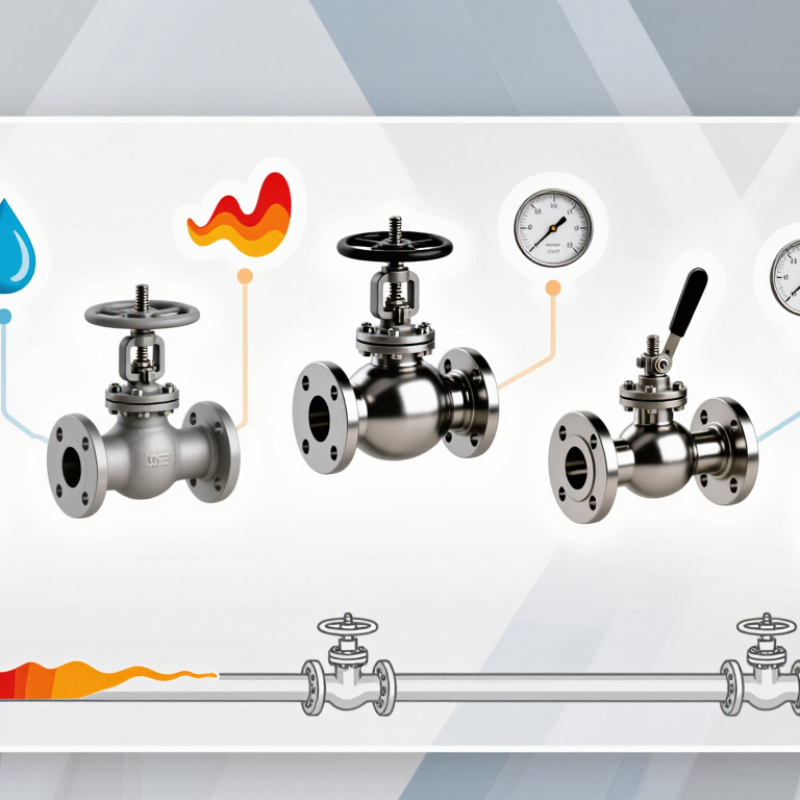
How to Choose the Right Valve for Different Applications?

Valve Functions and Key Selection Terms

Valve selection starts with function. Isolation valves stop flow; control valves modulate it; check valves prevent reverse flow; and relief valves protect against excess pressure. These jobs are not interchangeable. The U.S. Department of Energy’s Improving Steam System Performance sourcebook estimates that steam systems account for about 30% of industrial energy use, so valve leakage or poor control can affect more than one process line. That matters.

For a control valve, compare the required flow coefficient, or Cv, with actual flow and pressure-drop conditions. A valve that is too large may hunt at low flow; one that is too small can restrict capacity. Check shutoff requirements and leakage class, then confirm the pressure and temperature ratings against the process data. For steam or hot liquids, assess cavitation and flashing risk. Check the medium. Material compatibility matters, too.

A field detail can change the answer: a valve exposed to abrasive slurry may need different trim from one handling clean water. Review the full operating range, not only normal conditions, and specify the preferred failure position for actuated valves. Not just size. I would also verify assumptions with operating staff; instrument readings and maintenance history can reveal conditions missing from the design sheet. It is easy to over-trust a tidy specification.

Identify Process Conditions and Operating Requirements

Choosing a valve starts with the actual process, not the pipe size alone. Record the fluid, temperature, pressure, flow range, and whether the medium carries solids or corrodes materials. Then check start-up, shutdown, and upset conditions. A valve that works at steady flow may struggle when a pump starts or pressure drops sharply.

Operating requirements narrow the options. Specify the needed shutoff performance, response speed, control accuracy, and maintenance access. For a throttling service, estimate minimum, normal, and maximum flow; undersizing can restrict capacity, while oversizing may cause unstable control. Check pressure and temperature ratings against the full operating envelope, not just normal conditions. Small details matter. A pulsing line or sticky fluid can change the choice.

Energy use belongs in the review, too. The U.S. Department of Energy’s Improving Steam System Performance: A Sourcebook for Industry reports that many facilities can save 10–15% of steam-system energy through system improvements. That figure is not a guaranteed valve saving, but it shows why leakage, pressure loss, and maintenance deserve attention.

A spreadsheet can still miss a real-world nuisance: deposits may build faster than expected. Confirm assumptions with operating records, inspection findings, and, where possible, a trial under representative conditions.

Compare Valve Types and Their Operating Principles

Choosing a valve starts with its job: isolate flow, regulate it, or prevent reverse flow. A gate valve lifts a wedge clear of the passage, making it useful for open-or-shut service but less suitable for throttling. A globe valve redirects flow through a changing opening, offering finer control with greater pressure loss. Ball valves rotate a bored sphere for quick shutoff; butterfly valves turn a disc and suit compact, larger-bore lines. Check valves respond to flow direction, closing when flow reverses. Simple in principle.

The U.S. Department of Energy’s Improving Pumping System Performance sourcebook reports that pumping systems use nearly 20% of global electricity, and 25–50% of energy use in some industrial operations. That makes pressure loss worth checking, not guessing. For a hot-water line, compare the valve’s pressure-drop data at the actual flow rate; for a dosing line, consider how accurately it can hold a small opening. Control valves also depend on an actuator and a defined signal, while manual valves rely on operator adjustment. A perfect specification sheet cannot capture every installation detail. Pipe vibration, dirty fluid, and awkward access can change what works in practice. I would still question a valve choice based only on connection size.

How to Choose the Right Valve for Different Applications?

Compare common control-valve flow characteristics. The curves show normalized flow capacity versus valve travel; they illustrate standard characteristic shapes rather than measured performance for a particular valve.

Application guide: Linear characteristics suit processes where flow changes proportionally with valve travel. Equal-percentage characteristics are often used when system pressure drop varies, such as in many temperature-control loops. Quick-opening characteristics deliver much of their flow early in the stroke and are commonly used for on/off or rapid-flow service. Actual performance depends on valve design and system conditions.

Select Materials and Pressure Ratings for the Service

Choose valve materials for the actual fluid, not just the pipe size. Start with its chemistry, temperature, solids, and cleaning process. Carbon steel can suit many non-corrosive services, while stainless steel may resist some corrosive fluids. Chloride exposure can still cause pitting, so confirm the grade against concentration and temperature. Small chemistry changes matter.

Pressure ratings must match operating temperature and pressure, including surges. ASME B16.34 provides pressure-temperature ratings for many valve types and materials. Compare its limits with the highest expected service conditions, not only normal readings. Water hammer and frequent cycling can also stress a valve. The NACE IMPACT study estimated corrosion costs at US$2.5 trillion annually, about 3.4% of global GDP. That figure is a useful reminder: material mismatch can become an expensive maintenance problem.

Tips: Check the valve body and trim materials separately. Ask for pressure-temperature ratings and chemical compatibility data. Record peak pressure, temperature, and fluid composition before specifying a valve. One detail is easy to overlook: field conditions may differ from design assumptions. Recheck them with operating and maintenance teams.

Check Valve Sizing, Actuation, and Application Fit

Choosing a valve starts with operating conditions, not just pipe diameter. A 50-millimeter line does not automatically need a 50-millimeter valve. Check the required flow, pressure drop, fluid temperature, and viscosity. For a control valve, compare the expected flow range with its flow coefficient, often listed as Cv or Kv. An oversized valve may hunt at low flow; an undersized one can restrict capacity. Small details matter.

Actuation should match how the system runs. A handwheel can suit occasional adjustment, while electric or pneumatic actuators may fit frequent or remote operation. Check available power or air pressure, cycle frequency, control signal, and required fail position. For a check valve, confirm cracking pressure and installation orientation; a swing design may behave differently from a spring-loaded design. The fit is not always obvious from a catalog table, so verify the manufacturer’s technical data against actual conditions.

Tips: Record minimum and maximum flow, pressure, and temperature before selecting a valve. Note the fluid and any solids. Ask a qualified engineer to review unusual or safety-critical service. A neat calculation can still miss real operating swings, so leave room to question your assumptions.

How to Choose the Right Valve for Different Applications? — Check Valve Sizing, Actuation, and Application Fit

Valve Type Best-Fit Applications Sizing and Flow Considerations Actuation or Operation Key Limitations and Checks
Swing check valve Clean liquids in water, wastewater, and general process lines where low flow resistance is useful. Choose using flow rate, line size, allowable pressure drop, and the manufacturer’s flow data. Confirm that flow velocity is sufficient to keep the disc open. Automatic; the disc opens with forward flow and closes when flow reverses. No external actuator is normally used. May slam under rapid flow reversal. Installation orientation and permitted flow direction depend on the specific design.
Dual-plate check valve Compact installations in water, HVAC, and process piping where a short face-to-face dimension is beneficial. Match the valve to the required flow and pressure conditions; do not assume that nominal pipe size alone ensures suitable operation or pressure drop. Automatic; spring-assisted plates open with forward flow and close as flow falls or reverses. Check the specified orientation, flow range, pressure class, and suitability for the fluid. Spring and plate designs vary.
Lift or piston check valve Clean fluids in higher-pressure services where a guided closure element is appropriate. Review pressure drop carefully because the flow path can create more resistance than a full-flow swing design. Use rated flow coefficients where available. Automatic; forward pressure lifts the disc or piston, and reverse pressure returns it to the seat. Often unsuitable for fluids with significant solids or debris. Confirm the required piping orientation for the selected model.
Ball check valve Some wastewater, drainage, and slurry services where a simple, unobstructed closure element is useful. Size for the required flow while checking pressure loss, ball movement, and passage clearance. Allow for solids and viscosity in the selection. Automatic; forward flow moves the ball away from the seat, while reverse flow returns it to the seat. Verify material compatibility and minimum passage size. Ball weight and fluid properties can affect opening behavior.
Ball valve On/off isolation in water, gas, and compatible process services where quick operation and tight shutoff are needed. For control or frequent operation, check the valve’s flow coefficient and pressure drop at the expected operating point. A reduced-port design may restrict flow. Typically quarter-turn manual operation; electric, pneumatic, or hydraulic actuators can be fitted. Standard on/off designs are not automatically suitable for throttling. Check seat, body, and seal materials against pressure, temperature, and fluid chemistry.
Butterfly valve Large-diameter water, HVAC, and compatible process lines where compact construction and relatively low weight are important. Confirm pressure drop and the required control range, especially when the disc remains in the flow path. Select the correct pressure and temperature rating. Quarter-turn manual, gear-operated, electric, or pneumatic actuation is common. Seat and disc materials determine service compatibility. Verify shutoff requirements and flow direction for the selected design.
Gate valve On/off isolation in pipelines intended to operate mostly fully open or fully closed. When fully open, many designs provide a relatively unobstructed flow path. Size for line conditions and pressure class, not as a substitute for a control valve. Usually multi-turn handwheel operation; geared or powered actuators are available. Prolonged throttling can cause vibration, wear, and seat damage. Allow for the space and time needed for multi-turn operation.
Globe valve Flow regulation and throttling in process, steam, and utility services where controllability is more important than minimal pressure loss. Select using flow rate, inlet and outlet conditions, required control range, and valve flow coefficient. Expect greater pressure drop than with many straight-through designs. Multi-turn manual operation or modulating electric, pneumatic, or hydraulic actuation. Check cavitation, noise, flashing, and erosion risk where pressure drops are high or the fluid is near its vaporization conditions.
Check Valve Sizing and Application Checks
Selection Check What to Confirm Why It Matters
Design flow and operating range Minimum, normal, and maximum flow rates, including start-up and intermittent conditions. A valve selected only for nominal pipe size may not open reliably at low flow or may create excessive loss at high flow.
Pressure drop and opening pressure Available differential pressure, allowable pressure loss, and the check valve’s cracking-pressure or flow-performance data. The valve must open under expected forward-flow conditions and close effectively when flow stops or reverses.
Flow reversal and water hammer Potential for pump trips, rapid deceleration, column separation, or reverse flow; review the system transient conditions. Closure behavior affects slam and pressure surges. A suitable non-slam design may help, but system analysis may still be needed.
Fluid and materials Fluid composition, solids, viscosity, temperature, corrosiveness, and required seat and body materials. Material compatibility and passage design influence service life, leakage, fouling, and maintenance needs.
Actuator sizing Required torque or thrust at the worst operating conditions, differential pressure, temperature, and fail-safe action. Actuators must operate the valve across its full range without exceeding allowable stem or shaft loads.
Installation and maintenance Flow arrow, permitted mounting orientation, available access, piping support, and inspection requirements. Correct installation supports reliable operation and provides space for testing, repair, or actuator removal.

Note: Final valve and actuator selection should be based on the actual system flow, pressure, temperature, fluid properties, applicable codes, and published manufacturer performance data.

×
img

    Contact Info

    Phone number

    661-392-8948

    Address info

    3451 Pegasus Drive, Bakersfield, CA USA