
Blog
- Home
- Blog
Top 10 Galvanized Grating Suppliers Worldwide?
Choosing among the Top 10 Galvanized Grating Suppliers Worldwide requires more than comparing prices. It demands evidence. A reliable supplier should demonstrate coating quality, load performance, traceability, and consistent production across different project conditions.
The World Steel Association reported approximately 1.89 billion tonnes of crude steel production worldwide in 2023. This scale supports a broad supply base, but it also creates major differences in manufacturing discipline. Galvanized Grating may look similar in photographs. Its performance can differ sharply after installation. An experienced buyer should inspect steel grade, bearing-bar dimensions, weld quality, zinc coating thickness, and tolerances. Standards such as ASTM A123/A123M and ISO 1461 provide useful references for hot-dip galvanizing requirements. They do not replace project-specific engineering.
Corrosion deserves careful attention. The NACE IMPACT study estimated that corrosion costs could reach 3.4% of global gross domestic product. That figure is an older benchmark, yet its message remains practical. Better material selection can reduce maintenance, shutdowns, and replacement work. The International Zinc Association also highlights galvanizing’s role in extending steel service life under suitable exposure conditions. Still, no coating lasts forever. Harsh marine air, standing water, chemical contact, and poor drainage can shorten service life.
This guide evaluates ten international suppliers through a practical lens. It considers product range, certifications, export experience, customization, delivery reliability, and technical support. Supplier rankings are never completely universal. A manufacturer suited to a refinery walkway may not fit a rooftop access platform. That is the uncomfortable part. Buyers must verify current documents, samples, and references before signing contracts. Practical proof matters most.
What Is Galvanized Grating and Where Is It Used?
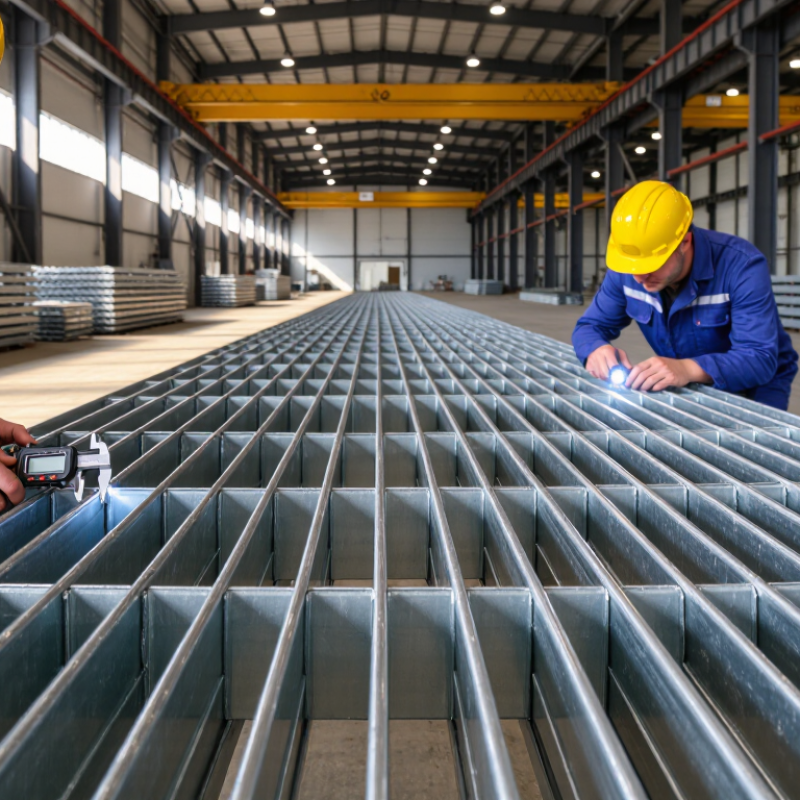
Galvanized grating is carbon-steel grating protected by a zinc coating, usually applied through hot-dip galvanizing. Its open grid allows water, mud, and debris to pass through. The result is a strong walking surface with improved corrosion resistance. It commonly appears on factory platforms, drainage channels, stair treads, bridge walkways, and rooftop service areas.
The American Galvanizers Association reports that hot-dip galvanized steel can provide more than 50 years of maintenance-free service in many rural environments. Industrial or coastal exposure can reduce that period significantly.
ISO 1461:2022 specifies coating requirements for fabricated iron and steel products, including minimum zinc thickness and inspection procedures. In practice, grating selection still depends on span, load, deflection, mesh size, and local exposure.
A heavy panel is not automatically the safest panel. That assumption needs correction.
Tips: Check zinc coverage after cutting or welding. Repair damaged areas with an approved zinc-rich coating. Keep bearing bars aligned with the main load direction. Site teams should also inspect slippery deposits, loose clips, and damaged supports. OSHA walking-surface guidance emphasizes secure, clean, and usable platforms, but each project requires engineering review. Galvanized grating is durable, not indestructible. Poor drainage, trapped moisture, and incompatible metals can still create early corrosion.
How to Evaluate Global Galvanized Grating Suppliers
Top 10 Galvanized Grating Suppliers Worldwide?
How to Evaluate Global Galvanized Grating Suppliers
Selecting a global galvanized grating supplier requires more than comparing quotations. The World Steel Association reported approximately 1.89 billion tonnes of crude steel production in 2023. This scale creates many choices, but volume alone proves little. Scale is not proof. Request mill certificates, coating records, welding procedures, and recent load-test results. Experienced buyers should verify whether the supplier manufactures grating or simply resells it. That distinction affects traceability, lead time, and corrective action.
Technical compliance should be checked against recognized requirements. ISO 1461 specifies minimum average zinc coating thicknesses, including 85 micrometres for fabricated steel over 6 millimetres thick. ASTM A123/A123M also provides useful hot-dip galvanizing criteria. Ask for measured coating readings, not a generic certificate. Look for accurate bearing-bar dimensions, consistent panel spacing, safe surface finish, and clearly stated load tables. Small errors matter.
Review zinc sourcing carefully. The International Lead and Zinc Study Group’s October 2024 forecast placed refined zinc usage near 13.5 million tonnes for that year, showing a large but changeable supply market. Compare quotation validity, packaging, corrosion protection, and delivery terms. A factory audit or independent inspection is valuable. It may reveal weak bundling or poor drainage design. Do not ignore communication quality. A supplier that answers quickly but vaguely remains a risk. My own evaluation would allow room for uncertainty, because no scorecard can predict every port delay, coating repair, or dimensional mistake.
Top 10 Galvanized Grating Suppliers Worldwide: How to Evaluate Them
This chart presents a practical, non-brand-specific scoring framework for comparing global galvanized grating suppliers. The suggested weighting emphasizes compliance, corrosion protection, structural performance, production capability, documentation, and delivery reliability. Buyers should adjust the weighting according to project specifications, local regulations, environmental exposure, and required lead time.
Top 10 Galvanized Grating Suppliers by Market and Expertise
A practical worldwide ranking should compare market coverage, manufacturing experience, and technical capability. North American suppliers often serve bridges, factories, and public walkways, with strong custom-order systems. Western European producers commonly focus on corrosion control, precise tolerances, and documented sustainability. Eastern European manufacturers may offer competitive fabrication for platforms and industrial stairs.
Asian suppliers cover a broad range. Chinese producers usually provide large-volume orders and varied panel sizes. Japanese and Korean specialists are known for careful welding and consistent surface quality. Indian suppliers often support heavy-duty infrastructure, including drainage covers and service platforms. Southeast Asian fabricators frequently adapt designs for humid, coastal environments. Middle Eastern suppliers understand high heat, dust, and demanding construction schedules.
Australia and New Zealand suppliers tend to emphasize workplace safety, load testing, and site-ready fabrication. South African suppliers commonly serve mining, utilities, and transport projects where impact resistance matters. Expertise is not only about production capacity. Buyers should check steel grade, zinc coating thickness, weld quality, panel flatness, and traceable inspection records. Ask for recent project references and sample test reports.
No list is perfect. Delivery reliability can change with steel prices, port delays, or local demand. A low quotation may hide extra cutting, packing, or certification costs. I would also question rankings based only on export volume; a smaller specialist may produce better-fit panels for a difficult site. Careful comparison remains essential.
Comparing Products, Standards, Capacity, and Service
Choosing among the top 10 galvanized grating suppliers requires more than comparing prices. Product quality starts with steel grade, bearing-bar depth, opening size, surface finish, and load capacity. World Steel Association data reported about 1.88 billion tonnes of crude steel production in 2023, showing the scale of the supply base. Yet large output does not guarantee consistent grating quality. Request mill certificates, coating records, and recent load-test results.
Standards reveal technical discipline. ISO 1461 specifies requirements for hot-dip galvanized coatings on fabricated iron and steel products. ASTM A123/A123M provides another widely used coating reference. Suppliers should state coating thickness, preparation methods, dimensional tolerances, and inspection procedures clearly. A useful comparison also checks whether serrated surfaces improve slip resistance in wet walkways. Small details matter. Drainage openings, weld quality, and cut-edge treatment affect field performance.
Capacity should be measured through actual monthly output, not impressive factory claims. Ask for production lead times, tooling availability, export packaging, and backup capacity during demand peaks. The World Bank’s Logistics Performance Index shows that delivery reliability remains a major supply-chain factor, even when manufacturing quality is strong. Service includes drawings, sample panels, engineering support, and responsive claims handling. Supplier questionnaires often miss communication quality. That is a weakness worth correcting. Coating-life estimates from the American Galvanizers Association indicate decades of atmospheric protection, but local humidity, salt exposure, and abrasion can reduce service life. A top-ten list should therefore compare verified evidence, not marketing language.
How to Choose the Right Galvanized Grating Supplier
Choosing the right galvanized grating supplier requires more than comparing prices. Start with the project conditions: span, load, panel size, walking direction, drainage needs, and exposure to moisture or chemicals. An experienced supplier should ask these questions before offering a quotation. If the sales team sends a price immediately, pause. The estimate may be incomplete.
Review the supplier’s manufacturing process and quality records. Ask whether the grating is hot-dip galvanized after fabrication, and request coating-thickness reports for recent batches. Check weld consistency, bearing-bar dimensions, panel flatness, and cut-edge treatment. A reliable supplier can provide drawings, load tables, material certificates, inspection photographs, and clear packaging details. Small samples help too. Hold one in your hand. Look for rough welds, uneven zinc, or warped frames.
Communication matters during production. Confirm tolerances, delivery dates, export packing, replacement procedures, and payment milestones in writing. A capable supplier should explain technical limits without hiding behind vague promises. I have seen low-cost panels create fitting problems because measurements were copied incorrectly. That mistake was avoidable, but not rare. Visit the factory when the order is large, or arrange an independent inspection. Compare at least three suppliers using the same specification, not three different assumptions. The best choice is usually the supplier that offers traceability, practical advice, stable quality, and honest answers when something needs correction.
(780) 669-9420