 (780) 669-9420
Why Choose Corrugated Suction Hose for Industrial Use?
Industrial plants rarely fail because a hose looks ordinary. They fail when suction collapses, fittings loosen, or abrasive slurry attacks the tube. That is why many operators choose Corrugated Suction Hose for demanding transfer work. Its flexible, ribbed construction bends around pumps, tanks, and tight equipment layouts. At the same time, reinforcement helps resist vacuum collapse during suction.
“Flexibility is valuable only when the hose still protects the flow,” says Daniel Mercer, an industrial hose applications engineer with more than two decades of field experience. His point is practical. A hose may bend easily, yet perform poorly under vacuum, heat, chemicals, or heavy abrasion. The correct selection depends on pressure, temperature, fluid composition, bend radius, and connection design.
Consider a wastewater pump drawing grit-filled water through a six-meter line. The hose may drag across concrete, vibrate against a steel frame, and operate continuously. A suitable Corrugated Suction Hose can reduce installation stress and maintain a reliable flow path. It can also simplify handling during cleaning or equipment relocation.
Still, corrugation is not a magic solution. Some designs sacrifice smooth internal flow for flexibility. Others need careful support near the coupling. Small details matter.
Real-world performance depends on inspection, storage, and installation. A crushed section may remain unnoticed until the pump struggles. Therefore, this guide examines why Corrugated Suction Hose suits industrial use, where it performs best, and where its limitations deserve honest attention. The choice is technical, but not always perfect. That is worth remembering.
What Is a Corrugated Suction Hose?
Why Choose Corrugated Suction Hose for Industrial Use?
What Is a Corrugated Suction Hose?
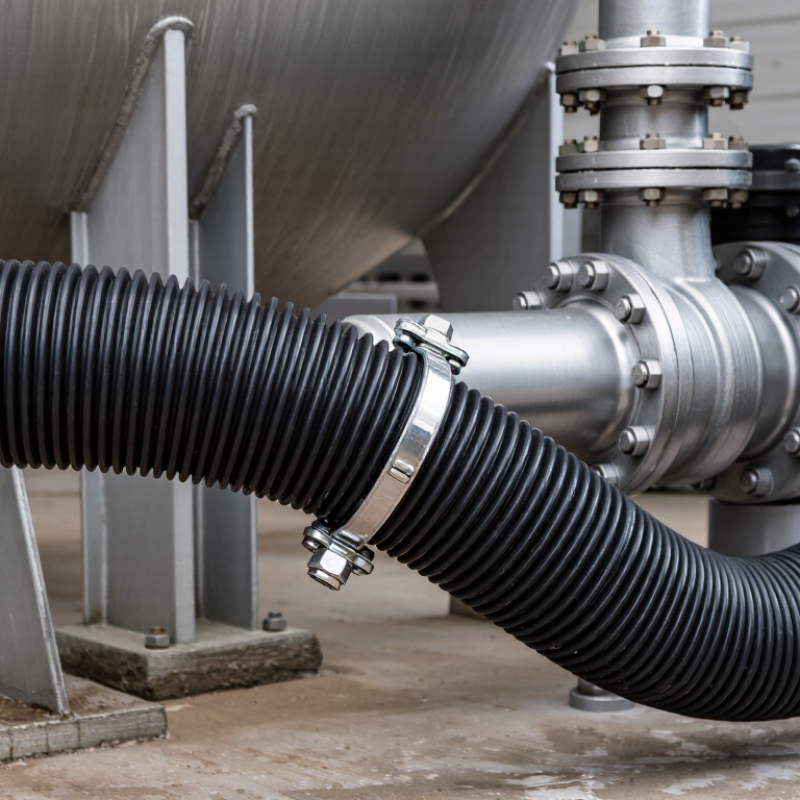
A corrugated suction hose is a flexible tube with raised ridges along its outer wall. Its inner passage carries liquids, slurries, powders, or light bulk materials. The corrugated shape allows the hose to bend around pumps, tanks, and uneven floors. A built-in helix or reinforcement helps prevent collapse during suction. This structure makes the hose practical for transfer systems that need flexibility and vacuum resistance.
It is not simply a softer pressure hose. Suction service can flatten weak tubing quickly. In field inspections, I have seen hoses fail near sharp bends, loose couplings, and heavily worn sections. Small cracks may admit air before workers notice visible leakage. That detail matters. Air entering the line can reduce pump performance and interrupt material flow.
Industrial users should match the hose construction to the media, temperature, pressure, and suction level. A hose for water may not suit abrasive slurry or chemical fluid. Check the inner diameter carefully, because a small restriction can increase flow resistance. Inspect the corrugations, end fittings, and grounding path when applicable. Replace damaged sections instead of relying on temporary repairs. The corrugations improve handling, but they also create grooves where dirt can collect. Cleaning and storage deserve attention, even when the hose looks durable.
Why Choose Corrugated Suction Hose for Industrial Use? - What Is a Corrugated Suction Hose?
| Data Dimension | Typical Information | Industrial Value | Selection Consideration |
|---|---|---|---|
| Basic Definition | A corrugated suction hose is a flexible hose with a ribbed or convoluted outer wall, usually supported by embedded reinforcement or a helical structure. | The reinforced construction helps the hose resist collapse when conveying liquids, slurries, air, or bulk materials under suction. | Confirm that the hose is specifically rated for suction or vacuum service rather than pressure-only discharge service. |
| Common Construction | Common materials include PVC, thermoplastic polyurethane, rubber, and composite constructions. Reinforcement may include a rigid helix, textile layers, or wire. | Different constructions balance chemical resistance, flexibility, abrasion resistance, weight, and temperature capability. | Match the liner and reinforcement to the conveyed medium and operating environment. |
| Vacuum Resistance | Many reinforced industrial suction hoses are designed for partial to high vacuum service; the exact rating is commonly stated in bar, kPa, or inches of mercury. | Vacuum resistance reduces the risk of hose flattening, flow restriction, and process interruption. | Use the published vacuum rating at the actual temperature, hose length, diameter, and bend configuration. |
| Flexibility | The corrugated profile allows repeated bending and routing around equipment more easily than a rigid pipe or smooth-wall hose of similar construction. | Improves installation in confined spaces and helps accommodate equipment movement and vibration. | Do not exceed the stated minimum bend radius, especially near couplings and under vacuum. |
| Typical Inside Diameter Range | Industrial suction hoses are commonly available in nominal inside diameters from about 25 mm to more than 300 mm, depending on the application. | Provides options for low-flow transfer, pump suction, tank emptying, dewatering, dust collection, and bulk-material handling. | Size the inside diameter to control velocity, pressure loss, pump requirements, and the size of any solids being conveyed. |
| Temperature Capability | Temperature limits vary widely: general PVC types may be suitable for moderate temperatures, while specialized rubber or thermoplastic hoses can support broader ranges. | Correct temperature selection helps prevent softening, embrittlement, liner damage, and loss of vacuum performance. | Evaluate both continuous and intermittent temperature, including heat generated by the conveyed material or surrounding equipment. |
| Abrasion Resistance | Reinforced rubber and polyurethane-lined designs generally provide better resistance to abrasive solids than basic flexible PVC designs. | Helps extend service life when handling sand, gravel, powders, pellets, sludge, or other materials with sharp or hard particles. | Choose a wear-resistant liner when the conveyed material contains solids or operates at high velocity. |
| Chemical Compatibility | Resistance depends on the hose liner, concentration, temperature, exposure time, and fluid composition. | Compatible materials reduce swelling, cracking, permeation, and contamination of the conveyed product. | Check a chemical-resistance chart for the exact fluid and operating conditions before installation. |
| Pressure Capability | Suction hoses can also have a positive-pressure rating, but pressure and vacuum ratings are separate performance limits. | Allows one hose assembly to support selected transfer operations when both ratings are suitable. | Never assume that a high vacuum rating means the hose is suitable for high discharge pressure. |
| Flow Efficiency | A corrugated interior can create more turbulence and friction than a smooth interior, particularly at high flow rates. | The flexible, collapse-resistant design may provide greater installation and suction reliability where routing is complex. | Consider smooth-bore alternatives when minimizing pressure loss is more important than flexibility and vacuum resistance. |
| Typical Applications | Applications include pump suction, water and wastewater transfer, dewatering, tank cleaning, dust extraction, slurry handling, and bulk-material conveying. | The same basic hose concept can support liquid, air, and solids-handling systems when the material and ratings are appropriate. | Verify suitability for food contact, hazardous locations, static control, or sanitary service when required. |
| Coupling and Installation | Common connection options include cam-and-groove couplings, threaded adapters, flanges, clamps, and hose-tail fittings. | Proper connections help maintain vacuum integrity and reduce leakage, hose pull-out, and unplanned downtime. | Use compatible fittings, correctly sized clamps, and support for heavy or long hose assemblies. |
| Maintenance Indicators | Inspect for flattened sections, cracks, exposed reinforcement, abrasion, chemical swelling, coupling damage, and reduced flow. | Routine inspection can identify degradation before a suction failure or fluid release occurs. | Replace the hose when structural reinforcement is damaged or when its vacuum performance no longer meets process requirements. |
| Main Advantage | A combination of flexibility, collapse resistance, and routing adaptability. | Makes corrugated suction hose a practical choice for mobile equipment, uneven layouts, and vacuum-driven transfer systems. | Choose it when installation flexibility and suction stability outweigh the lower friction typically offered by a smooth-bore hose. |
